
Montgomery County Dog License registration keeps pets listed with local authorities and shows lawful ownership. This process supports dog ownership standards set by Montgomery County and connects each pet with a verified record. Owners complete Dog registration Montgomery County to follow local regulations and keep details current. A valid pet license links to rabies vaccination data and contact details. That record helps animal control identify pets quickly. It builds trust between residents and local services.
Montgomery County Dog License programs give clear benefits for safety and community welfare. Many households complete Dog registration Montgomery County to support lost pet recovery and public health tracking. A visible license tag helps shelters return dogs to owners faster. Pet license records show proof of responsible dog ownership and legal compliance. Local regulations set this step for most dogs past a set age. Registered pets gain stronger protection through verified identification.
What is a Montgomery County Dog License?
A Montgomery County Dog License is an official registration issued by Montgomery County Government that confirms a dog has been recorded with local authorities. It provides identification through a dog tag and helps enforce health and safety rules within the community. A dog license, often called a pet license or dog tag registration, links a pet to its owner through local records. The licensing process usually involves submitting the dog’s details, proof of rabies vaccination, and a small fee. Once approved, the owner receives a tag that attaches to the collar and displays a unique number. This number helps animal control staff trace ownership if the dog gets lost or involved in an incident.
Licensing plays a role in community safety. Registration supports rabies control programs and helps track vaccination compliance. Montgomery County Auditor gives local agencies a method to reunite lost pets with families faster, which reduces shelter crowding. Many counties report higher return-to-owner rates for licensed animals compared with unregistered ones.
Purpose and Public Safety Benefits
A Montgomery County Dog License supports health monitoring and identification. Rabies remains a regulated disease in the United States, and pet licensing helps officials confirm vaccination records. This system promotes safer neighborhoods for residents, pets, and wildlife.
Key benefits include:
- Lost pet recovery: Tag numbers link to owner data in county databases
- Rabies prevention: Verification of current vaccinations
- Community accountability: Traceable ownership in case of complaints
- Animal welfare support: Licensing fees often fund shelters and control services
| Feature | How It Helps |
|---|---|
| Dog tag ID number | Matches pet to official registration |
| Vaccination record link | Confirms rabies compliance |
| Ownership database | Enables faster contact |
| Annual renewal cycle | Keeps records accurate |
Legal Duties for Dog Owners
Local ordinances require most residents to register their pets within a set timeframe after adoption or relocation. Licensing laws vary by jurisdiction, yet they typically apply to dogs above a certain age, often four months. Failure to register can lead to penalties or warnings from animal control.
Owners meet licensing duties through a simple process:
- Complete the pet license application
- Provide rabies vaccination proof
- Pay the registration fee
- Attach the issued dog tag to the collar
Who Needs a Dog License in Montgomery County?
Dog registration Montgomery County applies to most residents who keep dogs within county limits. It requires owners to register eligible pets, though certain cases qualify for exemptions with proper documentation. Local dog ownership laws define which animals must be registered. In most cases, dogs older than a minimum age — often around four months — must complete the pet registration requirements. Licensing rules apply to household pets, companion animals, and dogs that live at a residence for an extended period. Registration links the dog to an owner record and confirms rabies vaccination status.
Owners usually register dogs that meet these conditions:
- Age threshold: Dogs past the county’s required minimum age
- Residency status: Pets living within county boundaries
- Health compliance: Valid rabies vaccination proof submitted
- Permanent ownership: Dogs kept as household companions
Special Cases and Unique Situations
Certain dogs fall under special registration categories. This section outlines how Dog registration Montgomery County rules may differ for working animals, breeding operations, or temporary placements. Owners check local procedures through Montgomery County Government before submitting paperwork.
Examples include:
- Service dogs: Many jurisdictions waive fees with disability or training certification
- Breeder-owned dogs: Larger groups may require kennel permits or multi-dog licensing
- Rescue or foster dogs: Temporary housing can qualify for short-term registration status
- Working or therapy dogs: Verification papers support adjusted licensing terms
Exemptions and Required Proof
Some dogs do not require standard licensing. This section explains how exemption status works and what records support approval under county pet registration requirements. Filing the right paperwork keeps ownership records accurate and prevents compliance issues.
Typical exemption documentation:
- Veterinary records confirming age below licensing limit
- Official service animal certification
- Rescue organization placement paperwork
- Temporary relocation or transit verification
How to Fill Out the Montgomery County Dog License Form
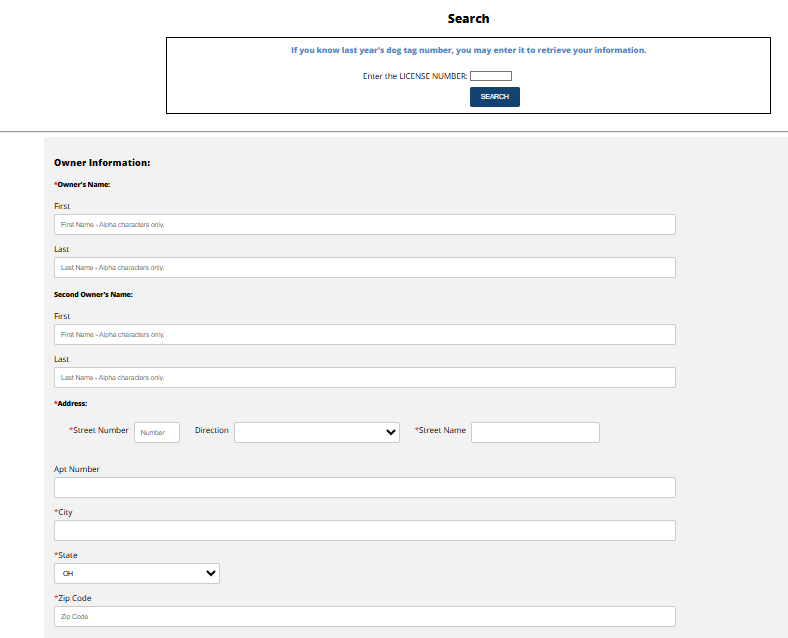
A Montgomery County Dog License is required for most dogs three months and older living in Ohio. Completing this license ensures pets are legally registered, helps with lost pet recovery, and confirms rabies vaccination compliance. The county offers online, mail-in, and in-person registration. The online form captures owner and dog information, applies fees, and issues a dog tag or certificate. Here’s a step-by-step guide to filling it out.
Official link: https://go.mcohio.org/applications/auditor/doglicense/dog_application.cfm?dis=6B3401
Owner Information
The first part of the form collects details about the dog’s primary and secondary owners. Accurate information ensures that authorities can contact you if your pet is found.
Information to provide:
- Owner’s name: First and last names (only letters allowed)
- Second owner (optional): For co-owners or family members
- Address: Street number, direction, street name, apartment number (if applicable), city, state (OH), and ZIP code
- Phone numbers: Primary required; secondary optional
- Email: Required; you can opt in for reminders about licensing and renewals
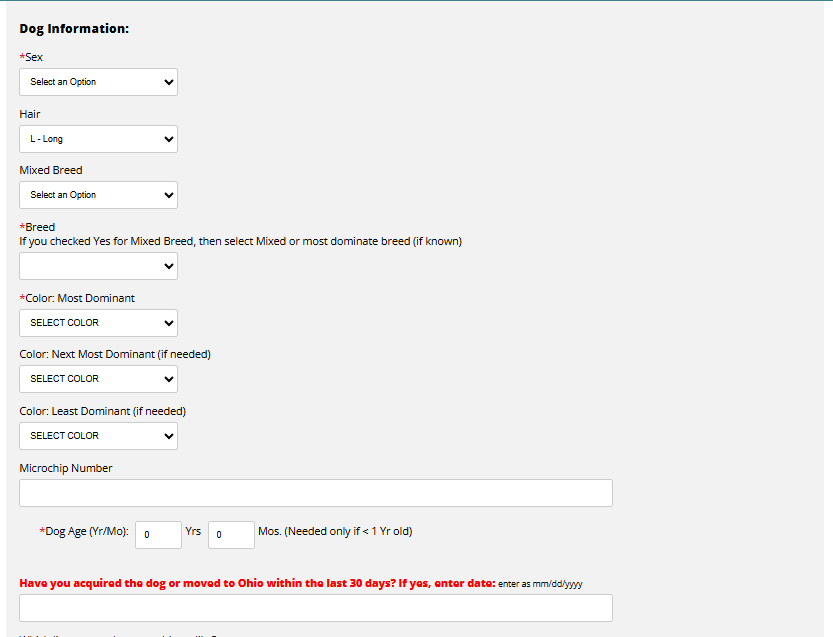
Dog Information
This section collects key details about your dog for identification purposes.
Required fields:
- Sex: Male or female
- Hair length: Short, medium, or long
- Mixed breed: Indicate yes or no
- Breed: Dominant breed or mixed breed if applicable
- Color: Most dominant, next most dominant, least dominant (if applicable)
- Microchip number: Optional but recommended
- Dog age: Only required if under 1 year
- Recent acquisition: Indicate if the dog was acquired or moved to Ohio within the last 30 days
License Tag Selection
Montgomery County offers several tag styles, each with associated fees:
- Standard Oval: $20
- Bone: Requires a $5 minimum donation ($25 total)
- Heart: Requires a $10 minimum donation ($30 total)
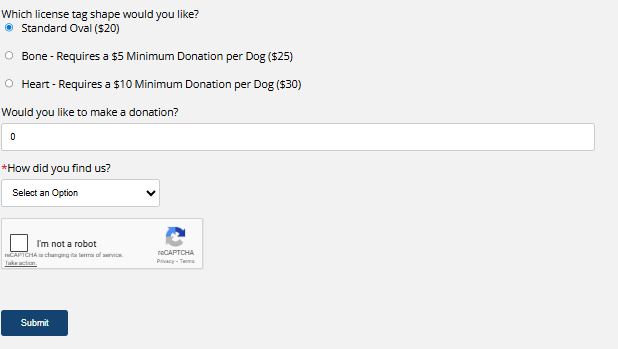
How You Found the Service
The form asks, “How did you find us?” This field is optional but helps the county improve communication and outreach.
Verification & Submission
Before submitting, complete the reCAPTCHA to verify you are not a robot. Then click Submit to finalize your application.
- Online submissions: Dog tag and certificate will be mailed to your address
- In-person submissions: Tags can be issued immediately at the Montgomery County Auditor or Animal Resource Center offices
- Replacement tags: Available for a small fee with proof of registration
Required Documents
Ensure you have the following ready:
- Rabies vaccination certificate — must be valid
- Owner identification — matches the address on the form
- Microchip record — optional but recommended
- Exemption documents — if vaccination is not possible
Fees & Payment Methods
License fees vary based on age, spay/neuter status, and tag type.
| License Type | Spayed/Neutered | Unaltered |
|---|---|---|
| 1 Year | $20 | $24 |
| 3 Year | $60 | $72 |
| Permanent | $200 | $240 |
Rabies Vaccination Requirements
A valid Rabies vaccination is required before a dog can receive a Montgomery County Dog License in Ohio. Owners must submit official vaccination proof showing the rabies shot is current at the time of registration. Ohio law treats rabies prevention as a public health priority. Since rabies is a fatal viral disease that affects the nervous system, strict compliance helps protect pets, wildlife, and residents. Keeping vaccination records updated ensures uninterrupted licensing approval.
State and County Requirements
Ohio law requires every dog three months of age or older to receive a rabies vaccination from a licensed veterinarian. This rule applies across the state and is enforced at the county level during the dog licensing process. The vaccination certificate serves as legal documentation and confirms that the dog meets public safety standards. County officials review this record before issuing or renewing a license. If the rabies vaccine is expired, the license application will not be approved until updated proof is submitted.
The official rabies vaccination certificate must include:
- Veterinarian’s name and clinic information
- Date the rabies shot was administered
- Vaccine manufacturer and serial number
- Expiration date of immunity
- Dog’s identifying description (breed, color, sex, age)
How to Obtain a Rabies Vaccination
Dog owners must schedule an appointment with a licensed veterinary clinic or attend an approved vaccination event. The rabies vaccine cannot be self-administered and must be given by a certified professional. During the visit, the veterinarian checks the dog’s health before administering the shot. After vaccination, the clinic provides a signed rabies certificate required for licensing. Keeping both digital and printed copies of this document makes future renewals easier.
Rabies vaccinations are typically available at:
- Private veterinary clinics
- Animal hospitals
- Community or seasonal vaccination clinics
Puppies usually receive their first rabies shot between 12 and 16 weeks of age, followed by booster schedules determined by the veterinarian.
Timeline and Renewal Rules
Rabies vaccination must remain valid for the full duration of the dog license. If the vaccine expires, the license cannot extend beyond that date. Many veterinarians offer one-year or three-year rabies vaccines depending on prior vaccination history. Owners must track expiration dates carefully to prevent lapses in compliance. Renewing the vaccination before it expires avoids penalties and keeps licensing active.
Important timing requirements include:
- First vaccination at or after three months of age
- Booster shots administered before expiration
- Updated vaccination proof during license renewal
- Immediate booster if the vaccine has lapsed
Dog License Renewal in Montgomery County
License renewal is required each year to keep your dog legally registered under Dog registration Montgomery County rules. Renewing on time prevents penalties and keeps your pet’s identification active in county records. In Ohio, dog licenses are valid for a set term, typically one year unless a multi-year or permanent option was purchased. Owners must renew before the expiration date printed on the tag or certificate. Annual renewal helps maintain updated vaccination records and correct owner contact details. Staying current supports lost-pet recovery and avoids unnecessary fines.
Renewal Deadlines
Dog licenses in Montgomery County usually renew during the official licensing period, which runs from December 1 through January 31 each year. Owners who obtain a new dog after this window must register immediately rather than waiting for the next cycle. Timely renewal keeps the dog legally compliant under Ohio law.
Missing the renewal deadline can lead to:
- Late penalties added to the base license fee
- Possible citation from animal control
- Extra processing charges
- Delays in receiving the updated tag
How to Renew Your Pet License
Residents can renew pet license records using online or in-person methods. The fastest option is the official online renewal portal through the county auditor’s licensing system. Owners enter the tag number, confirm contact details, verify rabies vaccination validity, and submit payment electronically. For those who prefer in-person service, renewal is available at the county auditor’s office or approved licensing locations. Mail-in renewals are also accepted if payment and updated vaccination proof are included.
The renewal process typically involves:
- Confirming owner contact information
- Verifying current rabies vaccination status
- Selecting license duration
- Paying the required fee
Fees and Penalties for a Dog License Montgomery County
A valid Dog License Montgomery County requires payment of the appropriate registration fee based on your dog’s status and license term. Paying on time keeps your pet compliant and helps avoid fines linked to unlicensed dog penalties. In Ohio, licensing fees vary depending on whether the dog is spayed or neutered. Altered dogs qualify for lower rates, which encourages responsible pet ownership. Owners can choose annual, three-year, or permanent license options depending on eligibility and vaccination validity.
License Fee Breakdown
License costs are structured to reflect sterilization status and duration. The county updates fees periodically, but the standard structure generally includes:
- 1-Year License (Spayed/Neutered): Lower base fee
- 1-Year License (Intact): Higher base fee
- 3-Year License: Available if rabies vaccination covers the full period
- Permanent License: One-time higher fee option
- Replacement Tag: Small processing charge
Late Registration Penalties
Failure to register or renew by the official deadline can result in added charges. The annual renewal window typically runs from December 1 through January 31. If payment is submitted after this period, late fees are applied automatically.
Common penalties include:
- Added late fee per dog
- Increased total registration cost
- Potential citation from animal control
Enforcement and Animal Control Notices
County animal control officers conduct routine compliance checks. If a dog is found without a valid tag, the owner may receive a warning notice or formal citation. Continued non-compliance can result in court fines or additional legal action. Keeping licensing current protects against enforcement issues, supports public safety programs, and keeps your dog legally registered under county regulations.
Lost Dog Recovery and License Benefits
A Montgomery County Dog License does more than meet legal requirements — it plays a direct role in lost pet recovery. When a licensed dog is found, the tag number connects immediately to the owner’s contact information in county records, speeding up reunification. In Ohio, licensed dogs have a higher return-to-owner rate compared to unregistered pets. The dog tag identification number links to updated address and phone records, which allows animal control officers to make fast contact. This simple metal tag often makes the difference between a quick pickup and a shelter stay.
How a License Helps Find Lost Pets
When a dog goes missing, every minute counts. A visible tag from a Montgomery County Dog License allows anyone who finds the pet to report the number to county authorities. Frequently Asked Questions staff can then pull the owner’s information from the registration system and arrange a safe return.
Licensing improves recovery because:
- The tag provides immediate identification
- Animal control can verify ownership quickly
- Updated phone numbers speed up contact
- Shelter intake staff can locate records instantly
Montgomery County Dog License Location
Residents who need in-person assistance for a Montgomery County Dog License can visit the official dog licensing office in Dayton, Ohio. This location handles applications, renewals, tag issuance, and general pet registration questions under county animal control services.
Official Dog Licensing Office
The primary office for Dog registration Montgomery County services operates under Montgomery County Dog Warden. Staff members provide guidance on licensing rules, rabies vaccination verification, and ownership documentation during regular business hours. Visiting the office can speed up processing, especially if documents require review or clarification.
Address:
3250 East Patterson Road
Dayton, OH 45430
United States
Phone: (937) 225-5663
Office Hours:
Monday – Friday
8:00 AM – 4:30 PM
Services Available at This Location
This dog licensing office provides several important services for pet owners. Staff members can answer questions about compliance, fees, and local regulations enforced by animal control in Montgomery County.
Available services include:
- Dog license registration
- License renewal
- Rabies vaccination verification
- Dog tag issuance
- Pet ownership inquiries
Directions & Accessibility
The office is located in the Dayton area and is accessible by major roadways. Public transportation routes serve nearby stops, making access convenient for residents without personal vehicles. On-site parking is available for visitors. The building provides accessibility features such as ramps and entry access for individuals with mobility needs. For easier navigation, consider embedding an interactive map showing directions to the pet license location. You can also place a small eligibility checker tool near the address section to help residents confirm whether they qualify for licensing before visiting.
Frequently Asked Questions
Dog licensing rules and procedures can raise many common questions for pet owners. In Montgomery County, Ohio, licensing helps ensure dogs are properly identified, vaccinated, and recorded in local systems. Understanding fees, renewal timelines, and compliance requirements can help owners avoid penalties and protect their pets. The answers below explain some of the most common concerns related to dog registration, renewal, and legal responsibilities. These FAQs are written in a simple format so readers can quickly find practical guidance.
How much does a dog license cost?
The cost of a dog license depends on the type of dog and the length of the license selected. Spayed or neutered dogs usually have a lower fee, while intact dogs may cost more. Multi-year licenses may be available when the rabies vaccination remains valid for the same period. Fees collected from licensing help fund animal control services, shelters, and lost-pet recovery programs in the county. Checking the current fee schedule before applying is recommended because rates can change periodically.
Can I register or renew a license online?
Many dog owners prefer online renewal because it saves time and allows payment from home. To complete the process, you normally need your previous license number and proof that the rabies vaccination is still valid. After submitting the application, the new tag is mailed to your address, which may take several days to arrive. Online systems are especially helpful during peak renewal months when offices are busy. In-person service is still available for people who prefer direct assistance or need help completing forms.
What happens if I don’t license my dog?
Failing to license a dog may lead to late fees, citations, or other penalties enforced by local authorities. Animal control officers sometimes issue warnings at first, but repeated non-compliance can result in fines. An unlicensed dog that is picked up may also face longer shelter holds or additional fees before release. Licensing ensures your pet is officially recorded, which helps authorities return animals to their owners quickly. Keeping the license current is the simplest way to avoid legal or financial problems.
How often do I need to renew the license?
Most dog licenses must be renewed every year unless a multi-year option has been purchased. Renewal deadlines are important because late applications may include penalties or extra processing charges. Many owners set reminders or mark renewal dates on calendars to avoid missing the deadline. Renewal also confirms that rabies vaccinations remain valid and that owner contact details are correct. Maintaining accurate records helps ensure you can be reached quickly if your dog is found.
Are service dogs required to be licensed?
Service dogs are generally required to be licensed just like other dogs, although fee exemptions or reduced rates may apply in some cases. Owners may need to provide documentation confirming the dog’s service status during the application process. Licensing still benefits service animals because it provides identification and ownership records in case the dog becomes separated from its handler. Animal control agencies and shelters rely on license information to contact owners quickly. Even when fees are reduced, registration remains an important legal requirement.